
Insights
Operation AI: Remove the Pain from Healthcare Administration.
Published 07/07/2026
Author: Mark Frost
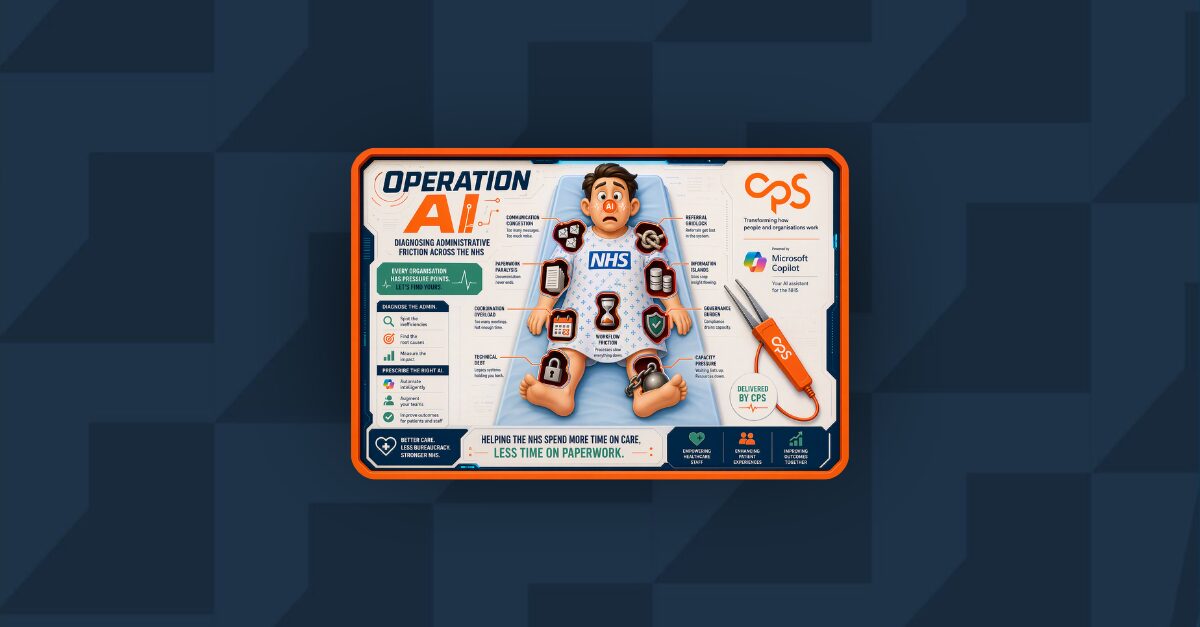
What we've learnt from helping healthcare organisations explore Microsoft Copilot and AI Agents.
For years, healthcare has been at the forefront of artificial intelligence.
Across the NHS and private healthcare, AI is already helping clinicians detect cancers earlier, analyse medical images, predict patient deterioration and support better clinical decision-making. These innovations are transforming patient outcomes and proving just how powerful AI can be when applied to clinical challenges.
Over the past couple of years, however, we’ve noticed something else.
While organisations are making incredible progress using AI to support clinical care, many are still facing significant operational challenges behind the scenes. Clinicians continue to spend valuable time completing documentation. Administrative teams are overwhelmed with repetitive processes. Managers are searching for information spread across multiple systems. HR, Finance and IT teams answer the same questions every day.
The technology that’s transforming diagnosis has the potential to transform these operational challenges too.
And that’s where we’ve seen some of the biggest opportunities emerge.
Diagnosis

Treatment Plan

Recovery
Symptoms
What We’ve Discovered
At CPS, we’ve had the opportunity to work with healthcare organisations at different stages of their digital transformation journey. Every organisation is unique, but many of the conversations we have begin with remarkably similar challenges.
Leaders rarely ask us how they can deploy AI. Instead, they ask how they can free up their people, reduce administrative burden and deliver better services with finite resources.
Across those conversations, several themes consistently emerge…
- Waiting list pressures continue to increase demand across services.
- Referral management often depends on manual processes and disconnected systems.
- Clinical documentation consumes valuable time that could otherwise be spent with patients.
- Appointment scheduling and patient correspondence remain resource-intensive activities.
- Multidisciplinary teams need quicker access to accurate information to make timely decisions.
- Reporting and compliance requirements continue to grow, while information governance remains critical to maintaining trust.
Overlay all of this with workforce shortages, financial pressures and ambitious productivity targets, and it’s easy to see why so many healthcare organisations are exploring AI, not as a technology initiative, but as a way to help people work differently.
One thing has become increasingly clear to us. Healthcare doesn’t lack talented people.
It lacks time.

Diagnosis
Looking Beyond Clinical AI
When people hear the phrase “AI in Healthcare”, the conversation understandably turns towards diagnosis, imaging and clinical innovation.
Those areas will continue to evolve, and rightly so.
However, through our own work with customers, we’ve found that some of the quickest opportunities to deliver value often exist outside clinical settings.
Operational processes. Administrative workflows. Knowledge management. Employee productivity.
The everyday activities that keep healthcare organisations running.
When we run discovery workshops, we don’t begin by talking about Copilot or AI agents. We begin by asking questions.
- Where are clinicians spending time on administration instead of patient care?
- Which departments are repeating the same manual activities every day?
- Where are staff searching across multiple systems to find the information they need?
- Which processes create frustration for employees or delays for patients?
- Where are teams doing work that technology could safely support?
Those conversations almost always uncover opportunities that organisations hadn’t previously considered.
Rather than replacing existing systems, AI often complements them, connecting information, reducing repetitive work and helping people access knowledge more quickly.
That’s when the conversation changes from technology to outcomes.
Treatment Plan
Why We’re Talking More About Agentic Healthcare
Much of the discussion around AI still focuses on Microsoft Copilot, and for good reason. Giving every employee an intelligent assistant can have an immediate impact on productivity.
But what we’re increasingly discussing with customers is what comes next.
Agentic AI.
Rather than simply responding to prompts, AI agents can support repeatable business processes, retrieve information from multiple systems, complete routine tasks and work alongside employees under appropriate governance.
The possibilities are significant.
We’ve explored scenarios where agents support recruitment teams, answer HR questions, help manage patient communications, retrieve organisational knowledge, automate finance processes and reduce pressure on IT service desks.
These aren’t futuristic concepts.
They’re practical use cases that help organisations remove friction from everyday work.
And importantly, they allow highly skilled people to focus on activities where their experience, judgement and compassion make the greatest difference.

Recovery
Productivity Is Only Part of the Story
One thing we’ve become increasingly aware of through customer conversations is that productivity is rarely the real objective.
It’s the outcome.
The real objective is creating a healthier organisation.
When we speak with NHS leaders, the conversation often returns to the same themes.
- How do we improve the experience of our employees?
- How do we reduce pressure on our workforce?
- How do we retain talented people?
- How do we give clinicians more time with patients?
Administrative overload doesn’t just reduce efficiency. It affects morale, contributes to burnout and can make already demanding roles even more challenging.
That’s why we believe the greatest value of AI isn’t measured purely in hours saved.
It’s measured in the experience it creates for the people using it.
- Every repetitive task removed.
- Every policy found instantly.
- Every report drafted in seconds.
- Every administrative process automated.
These small improvements accumulate into something much bigger, a workplace where technology supports people rather than slowing them down.
For us, that’s where Microsoft Copilot and AI agents become transformational.
Not because they replace people.
Because they give people back the time to do what only they can do.

Long-Term Health
Where We Think Healthcare Is Heading
If there’s one thing we’ve learnt from working across Microsoft’s AI ecosystem, it’s that healthcare is entering a new phase of transformation.
The first phase focused on clinical innovation.
The next phase will focus on organisational innovation.
Forward-thinking healthcare organisations are beginning to look beyond individual productivity tools and ask bigger questions about how AI can improve the way entire departments and organisations operate.
This is where we believe Agentic Healthcare will become increasingly important.
Not as a buzzword.
Not as another technology trend.
But as a practical way of connecting people, knowledge, processes and systems to remove unnecessary friction from everyday work.
We don’t believe the future of healthcare is about replacing clinicians or administrators with AI.
We believe it’s about creating organisations where technology quietly handles routine work, enabling people to spend more time applying their expertise, collaborating with colleagues and delivering exceptional care.
Healthcare has always been about people. Everything we’ve seen suggests AI is at its best when it helps those people do what they came into healthcare to do.
Care.
Every organisation has operational pain points
The question isn’t whether they exist, it’s where they’re having the greatest impact.
At CPS, we’ve found that the most successful AI programmes don’t begin with technology.
They begin with curiosity.
Understanding where time is being lost.
Listening to employees.
Mapping processes.
Identifying opportunities.
Only then do we explore how Microsoft Copilot, AI agents and the wider Microsoft AI platform can help. Because the best AI projects aren’t about deploying new technology.
They’re about building healthier organisations, where employees spend less time on administration, more time on meaningful work, and ultimately deliver better outcomes for the people who matter most.